Monday, June 9, 2014
What a Difference a Year Makes
So, one year ago I was just starting into CPE, which began a journey that I could never have foreseen. I went through what has to have been of the worst years for me emotionally as an undiagnosed anxiety disorder turned into an undiagnosed panic disorder. This week, I finished up an entire of week of solo parenting and getting Sam out of the house to do things. This would have been unimaginable a mere 3 months ago, but I have done it. I fell apart a little at the end, but such is life. The important thing is that I know I can do it now, and I have ideas for how to do it better next time. I am slowly, but surely becoming a more functional person again, and that is a great gift.

Friday, May 2, 2014
My Public Statement on the Environment and Food
In a way, this blog is a part of my public statement to be made for this class, but here is my best shot at compiling it into one coherent place.
I think that there is something deep in the Christian faith in regards to the call to be caretakers of the garden. I have often wondered if the decline in Protestant Christianity isn’t related to the decline in family farming. The faith drives us to the land, and the land informs our faith. As our society tries to master our surroundings and deny our reliance on God for daily bread, we have tried to force the land to grow crops it wasn’t meant to in a volume that is not sustainable.
One of the big defences for this kind of farming is that it is “feeding the world,” but is it really? So much of our land is used to grow corn that is used to make ethanol or corn syrup, both inefficient uses of corn and the land, particularly given corn’s tendency to diminish the land it is grown on.
I also think that there is an American hegemonist arrogance in assuming that it is our job and responsibility to feed the world, as if there is nowhere else in the world that can grow food or that national food self-sufficiency isn’t a value. As a species, we need to learn to better live within our means and to face the reality that we may not be able to eat fresh fruit year round or have an inexpensive avocado salad in Minnesota.
Ultimately, though, we can each only do what we can. For our part, my family tries to eat local and in season. Once we own a house with room for a larger pantry, we hope to start preparing and canning more fruits and vegetables, so that we can have them fresh in season, and preserved through the winter. I know that this will not put any big farms out of business, but it might help some small farms stay in business, and it will help us really think about where our food comes from. And that is what I think the most important part of environmental education is.
Our Time Together as a Class
So, as part of my Creation Care class, we spent a weekend together at Shalom Hill Farm being in creation and learning about farming practices. For me, it was a beautiful weekend that encouraged me to think about my continued relationship with creation and particularly with how and where I want to live.
Up until this point in my life, I had never felt the call to exist in a rural setting. I am a city kid, though I have some experience on a farm, thanks to my great-uncle Wes. My mom would take me to his small farm where I fed chickens, slopped hogs, pitched hay, and nursed calves for a week or so every summer growing up. All of their animals were free range, though not pasture fed. There was no automation, and we would get in the pens with the cattle and the hogs to feed and care for them.
Being back in a farm setting made me nostalgic for those days, and seeing what they’ve done with the Shalom Hill Farm has made me consider if there’s a way to combine that kind of life with the call I feel toward collegiate ministry in a similar way to how they have. That is, bringing students and classes in to experience life in a rural/farm setting and to reflect on the lessons that can be learned there.
I will continue to reflect on this, and if I end up in Eastern Wisconsin, I may ask my uncle if he would sell or leave his farm to me to turn into a learning center. As with so many of my experiences in seminary, I am left with more and more possibilities open to where God could be leaving me.
A Social Statement I Can Get Behind
I think that the ELCA’s statement on the environment bears a much closer resemblance to how I would talk about this subject. To begin with, they lay out a framework for discussion and then support that framework with biblical and historical citations. This pattern is repeated throughout the document, with biblical citations supporting a call to reflection and action. As opposed the the Methodist statement, this is a document that a lay person could definitely understand and discuss without special guidance or education.
I also appreciate and feel affirmed by the emphasis on individual action in the ELCA’s environmental statement. Helping my son grow a garden is making a difference in education as well as self-reliance, and together we can advocate as part of a larger group, but the emphasis here is on encouraging individuals to contact their representatives, rather than addressing national leadership as a denomination. The ELCA aims to inform and educate its membership for action rather than act on behalf of that membership. While this runs the risk of a membership whose voice isn’t heard, it makes it more authentic and powerful when the church stands together and speaks as one voice in unity of purpose.
The ELCA’s statement also includes a list of ways to move towards sufficiency and environmental justice as well as calling for personal reflection on how our lives impact the environment and how we are, in turn, impacted by the current state of the environment.
These are the values I want to teach my son, and the route of advocacy that I think a church should be taking.
http://www.elca.org/caringforcreation
Even More Conclusions
Sandra Steingraber’s Living Downstream paints a bleak portrait of the state of the environment in America right now, and what is most worrisome is how much of it I think we all know to be true. She speaks a lot of silence surrounding loss and cancer, something I can relate to. I only recently found out that when my grandmother was in the hospital when I was a kid, it was for cancer treatments.
I think part of the silence around what the chemicals are doing to the world is fear of what will happen if we stop using them. We don’t want to think about what will happen if we stop using pesticides or if Round Up Ready Corn goes off the market.
This was one of my concerns with the project I selected to try with my son. I couldn’t say for sure what was in the soil it came with, or whether the seeds were heritage seeds. Heck, we were growing them in a styrofoam and plastic garden, right up against some petrochemicals that could leach into the soil if we weren’t careful.
How do we go about trying to get the chemicals out of the soil? How do we clean up the rivers and the lakes when so much of what we depend on adds these chemicals right back? I think here we need to go back to Schut’s book and remind ourselves that we can only do what we can do and try to not add more chemicals back into the system, buy from farmers who use organic fertilizers and pesticides, and do both of those things as we can afford to do them. Living Downstream is certainly a call to action, but I worry about people being afraid that they aren’t doing enough.
Steingraber, Sandra. Living Downstream: An Ecologist's Personal Investigation of Cancer and the Environment. Cambridge, MA: Da Capo Press, 2010.
Responding to the Methodist Environmental Statement
Being married to a woman of Methodist leanings and friends with several Methodist pastors, I have become accustomed to the highly idealistic nature of the UMC church, but that did not prepare me for the nature of the UMC’s “Church Statement on the Environment” and its proposals.
Don’t get me wrong, I love the kind of optimistic idealism that the Methodist church brings to the table, but I don’t think that we can fix the environment and rural racism in the same committee. They declare their end goals with few to no proposals for the means of accomplishing those goals, which can make it difficult to instruct people. As we experienced in our farm visits, sustainable agriculture does not mean the same thing to everybody, and not everyone agrees on what responsible land management looks like.
I think that one of the problems we have right now is people not understanding what things like land management or carrying capacity are, and this statement uses these terms without explaining them, making it inaccessible to the everyday parishioner and requires that the pastor intervene in explaining them.
We also need to start with education that leads to action, rather than starting with action that leads to education. Otherwise, it’s much harder to get people to sign on to a statement or a course of action. People are far more prone to action if they understand the why first and feel that they have a part in shaping policy.
http://www.acton.org/public-policy/environmental-stewardship/theology-e/united-methodist-church-statement-environment
Thursday, May 1, 2014
Conclusions Part 2
David Orr's Earth in Mind reflects very deeply my views about what we teach our son at home and how we try and teach him. Orr says that one of the deepest issues in modern education is teaching our children to "find careers before they find a calling" (Orr 22). That is, we teach them to see education as a means to making money, rather than part of becoming a complete person. Part of my goal in teaching Sam about growing vegetables was to help him realize where his food comes from and that he can be a part of growing it, no matter what he chooses to do with his life. Understanding the food production chain, knowing how seeds grow, and knowing how to care for food are major parts of what I view as a holistic education.
For good or for ill, what I ended up teaching my son is that growing food is much harder than it looks, and that not all food can be grown just anywhere. While a valuable lesson, it is much harder for a three year old to accept a lesson from failure than from success, but he seems to have taken it well. However, much like Orr proposes, I have made the earth and our relationship to it an early part of Sam’s education, and I think there is something meaningful in acknowledging that there are failings in our relationship with creation.
Orr, David W. Earth in Mind: On Education, Environment, and the Human Prospect. Washington, DC: Island Press, 2004.
Conclusions Part 1
So, this is the first in a multi part blog series. Each one reflecting on my creation care project through the lens of one of the books we read for this class and through some official church statements. First, we’ll start with Michael Schut’s Simpler Living Compassionate Life.
This book addresses the practical aspects of living a simpler life as well as one that shows a greater level of care towards one another and toward our environment. This is part of why we chose to try and grow some root vegetables in our little experiment. I agree with Schut that growing our own food is one of the best things we can do for ourselves, our community, and the environment. I have some degree of experience growing things like tomatoes, peas, and string beans, but I have never grown root vegetables. I was excited to learn with my son what it would be like to grow root vegetables, and to get to watch them grow beneath the soil. Unfortunately, this wasn’t to be, but there was learning even there per my last post.
"We are caught in a destructive system, and we find that even our will to refuse to identify with that system is mixed with the desire to enjoy its fruits. None of us is innocent, either in intention or behavior. At most we ask that we may be helped to open ourselves to re-creation by God, but we also depend on grace in another sense. It is only because we know ourselves accepted in our sinfulness that we can laugh at our own pretenses, live with a measure of joy in the midst of our halfheartedness, and risk transformation into a new creation." (Schut, 123)Schut, Michael. Simpler Living, Compassionate Life: A Christian Perspective. New York: Morehouse Publishing, 2008.
Saturday, April 26, 2014
Post-move project reflecting
So, it's been a while, and for this I apologize. Our class has gone to the farm and returned, and we have moved since the last time I posted. By the time we moved, things were not looking great for our little root garden, and alas, it died in the move. I won't post any depressing pictures here, but fortunately, Sam just sort of forgot about it.
Initially, I tried to figure out why it died. Had I not watered it enough? It was always hard to tell the water level in the reservoir. Maybe it wasn't getting enough sunlight? We were living in a Northerly facing apartment with limited sunlight. Perhaps the water was too hard? We did end up with a shower head that was clogged from mineral build up. Ultimately, all of these things probably contributed to it, but the one that probably contributed the most was that, between being a student and being a parent, it became something that I felt obliged to do, rather than something I wanted to do. Thus it became difficult for me to invest time and energy in a garden that would not produce something I could show off for several weeks, and I did not pay attention to what the garden was telling me. Now it's dead and you can only learn so much from a plant autopsy, and the only thing to be learned from such an analysis is that I'm bad at growing indoor plants, something I've known for years now.
Now that we've settled in to our new place, I've been reflecting on this garden, as well as other things that have happened in my life, and I think a big part of creation care is acknowledging that sometimes the right thing to do is to scrap a project or idea and start over.
This summer, we'll try growing something in our apartment's community garden, and we'll talk about the environment we live in and where our water comes from, but right now, we need to admit that trying to grow root vegetables indoor was not a success, but talking about plants was, and move on from there.
Friday, March 7, 2014
Two Weeks In
 Fewer pictures this time, I apologize in advance, but I don't think I'll ever live up to the visual glory of the previous post. First off, the bean sprout proved to be a good visualization for Sam of what was happening underneath the dirt. We were able to talk about how the plant grows out of the seed. and sends out roots to look for water and food. Sam seems to get this, but he was more excited about the radishes and the carrots starting to sprout. No signs of the onions doing anything yet, but the radishes are sprouting well. You can see them well in the picture I took, unfortunately the carrot shoots are still too stringy to see well. We still cannot see the roots through the view window, but hopefully that will be better next week.

The other major encounter we had with nature in the past couple weeks was when we went to a family camp weekend with our church. Unfortunately, Sam had a croup attack the weekend before, so we were hesitant about him going outside, but there was a real joy in being in a lodge with a group of other families, which dissipated parenting responsibilities across the parents and older children. Being an only child, it's important to give Sam the experience of community so that he can understand the importance of the church and why we care for creation. We have to make sure that there is room enough and food enough for everyone on the planet, and we are responsible to preserve the beauty of God's creation for one another and for future generations.
Friday, February 21, 2014
Setting Things Up
For those who want to play along with the home game, this is what we are using for this project:

and it is available here
Sam has been super excited about this project, ever since it arrived in the mail. I worry that he expects the veggies to be that size right away, but that's part of the learning process. We begin with the unboxing:
While I was hoping it was plastic or something sturdier like that, this is a styrofoam garden box. I'm not sure how I feel about this. On the one hand, modern styrofoam breaks down better than plastic. On the other hand, that means this is pretty much a one and done kind of thing. Styrofoam is not known for its reusability, so we will probably have to dispose of it after we harvest our bounty. We'll see. If it can keep going, that will be really nice, and maybe we can try some other plants in here. I've had my eye on some habanero peppers from the Seed Savers catalog.
One very nice thing about this garden is that it waters the soil using a wicking system, meaning I don't have to worry about Sam overwatering it in his three year old enthusiasm, but that I can still let him help with watering it.
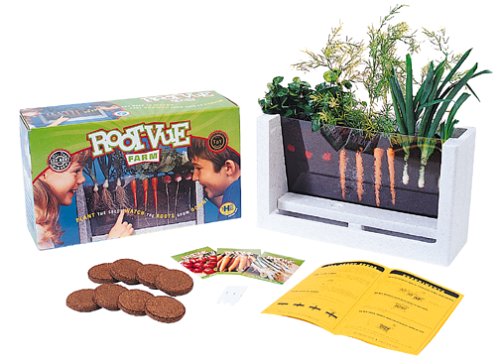
and it is available here
Sam has been super excited about this project, ever since it arrived in the mail. I worry that he expects the veggies to be that size right away, but that's part of the learning process. We begin with the unboxing:
 |
| I've never seen a garden with so many instructions before. |
 |
| Cutting the wicks |
After the unboxing process, I realized that the bag of dirt it came with was not just a bag of dirt. I read the instructions and realized that we were going to have to make dirt in the kitchen. After conferring with my wife, she GRACIOUSLY allowed us a bowl and a wooden spoon with which to make the dirt. Sam wanted to stir, and I foolishly let him, which meant a quarter cup of freshly mixed dirt on the kitchen floor. Fortunately it needed sweeping anyway, so we did that. After that, we opened the seed packets that came with the kit, planted them and put water in it. Now we wait.
After everything was set up, Sam started wondering when he would get to see the plants, and after a failed attempt at explaining sprouting, I remembered a science experiment I did in early middle school and set up a glass with water, a paper towel, and some great northern beans we had in the cupboard. Hopefully these will sprout over the next few days, so Sam can see how this whole process starts.
I am very excited about this project and look forward to following it through to (hopefully) edible vegetables.
I hope Sam has questions about what is going on, because I am nervous about coming up with things to tell him about if he doesn't. I have faith in his inquisitive nature, and he and I have a good rapport when it comes to talking about God and creation, so it will probably be much easier than I'm anticipating.
 |
| Dirt pucks waiting to turn into soil |
 |
| Three year old too excited about making dirt |
 |
| "Can I stir it?" |
 |
| My lovely wife modeling our dirt. |
 |
| Planting the seeds. |
 |
| Radish, Carrots, and Onions, Oh My! |
 |
| I had no idea carrot and onion seeds were so small |
 |
| Side project |
After everything was set up, Sam started wondering when he would get to see the plants, and after a failed attempt at explaining sprouting, I remembered a science experiment I did in early middle school and set up a glass with water, a paper towel, and some great northern beans we had in the cupboard. Hopefully these will sprout over the next few days, so Sam can see how this whole process starts.
I am very excited about this project and look forward to following it through to (hopefully) edible vegetables.
I hope Sam has questions about what is going on, because I am nervous about coming up with things to tell him about if he doesn't. I have faith in his inquisitive nature, and he and I have a good rapport when it comes to talking about God and creation, so it will probably be much easier than I'm anticipating.
Starting this Blog
I am starting this blog as part of my Creation Care class in Seminary. We need to journal and to keep track of our Creation Care project, and I am using this medium to do both. Follow along for further developments.
Subscribe to:
Posts (Atom)